- Key Takeaways
- What you’ll learn
- Reader fit
- Important limitations
- Terminology used throughout this article
- What Are AI Overviews?
- Terminology + Boundaries
- Citation Mechanics (What’s Observable)
- Importance
- Why SEOs Should Care
- When AI Overviews Help vs. Hurt
- Eligibility
- Prerequisites (Must Be True)
- Selection Signals (Improve Odds, Not Guarantees)
- Non-Guarantee Statement
- How AI Search Selects and Generates Sources
- Feature Set
- Retrieval and Generation
- Source Selection
- Query Targeting for AI Overviews
- Long-Tail Queries
- Question Queries
- Intent Mapping
- Content Structure for AI Overview Inclusion
- Answer Blocks
- Formatting
- Tables
- Headings
- Content Quality Signals (E-E-A-T)
- Primary Sources
- Authorship
- Editorial Review
- Topical Authority and Internal Linking
- Topic Clusters
- Internal Linking
- Entity Coverage
- Structured Data for AI Overviews
- Schema Types
- Implementation
- Validation
- Technical SEO Requirements
- Crawlability
- Indexing
- Performance
- Mobile
- Rendering
- Technical sign-off before chasing AI Overview citations
- Measurement and Reporting
- Search Console
- Log Files
- Rank Tracking
- Citation Tracking
- Common Mistakes That Prevent Inclusion
- Keyword Stuffing
- Thin Content
- Mismatched Intent
- Outdated Content
- FAQ
- How long does it take to appear in AI Overviews?
- Does schema guarantee inclusion?
- Can small sites appear in AI Overviews?
- How to prevent content from being used in AI Overviews?
- How to measure AI Overview citations?
- Implementation Checklist (Next 7 Days)
- Measurement Baseline
- Risk and Expectations
- If You Only Do One Thing
Key Takeaways
- Optimize for a 3-path system: AI Overviews visibility comes from (1) being cited, (2) earning the citation-panel link, and (3) ranking in classic blue links that feed retrieval—ignore any one path and you cap upside.
- Win the eligibility layer first (technical): If pages aren’t crawlable, renderable, and indexable (canonical alignment, no
noindex, mobile parity, Core Web Vitals, server-rendered primary answer), your content and schema won’t matter. - Target queries that actually trigger AIOs: Prioritize keywords that pass the five checks—answerability, decomposability, verifiability, competitive scarcity, and user clarity—then lean into long-tail patterns and question formats that map cleanly to extractable answers.
- Write for passage-level extraction: Use answer-first formatting with standalone answer blocks (50–70 word direct answer, TL;DR bullets, or 3–7 step mini-process), keep one paragraph = one purpose, repeat the full entity name, and format like it will be quoted out of context—because it will be.
- Make trust extractable (E-E-A-T as on-page signals): Add primary-source citations, authorship blocks, reviewed-by lines, timestamps, and change logs so Google can safely ground and attribute claims—especially on volatile or YMYL topics.
- Use structured data as a clarity layer (not a shortcut): Match schema to intent (Article/FAQPage/HowTo/Product/Person/Organization), deploy JSON-LD with a unified
@graph, validate with Rich Results Test + Schema Markup Validator, and prevent schema drift after CMS edits. - Instrument or you’re guessing: Build an AIO candidate query set in Search Console, track citation count, AIO-triggered queries, CTR deltas, crawl/index coverage, rank distribution, and separate URL citations vs brand-only mentions—then run test → measure → iterate on a 14–28 day cycle.
Showing up in Google AI Overviews isn’t one tactic—it’s a system. You’re optimizing for three outcomes at the same time:
- Being cited as a source inside the AI-generated summary
- Earning a link from the citation panel
- Ranking in classic blue links that feed the AI Overview’s retrieval layer
This guide walks through the workflow I use to increase search visibility across all three pathways as part of a modern search engine optimization program shaped by rapid advances in Artificial Intelligence.
What you’ll learn
- Query Targeting for AI Overviews: identify question patterns and search behaviors that trigger AI Overview displays through keyword research, query analysis, and SERP analysis
- Structured Data for AI Overviews: implement schema markup that helps Google extract and attribute content, improving content inclusion
- Measurement and Reporting: track AI Overview appearances using Search Console and third-party SERP monitoring, plus search visibility tracking and AI search monitoring
- Key Considerations, Risks, and Controls: manage snippet visibility, understand traffic trade-offs, and maintain editorial standards with preview control
Reader fit
This article targets in-house SEO teams, agency strategists, content leads, and publishers with indexable websites and active Google Search Console access—including teams responsible for enterprise-level optimization, high-level strategy, and measurable client ROI.
Important limitations
Inclusion in AI Overviews is not guaranteed. AI-generated summaries vary by query category, geographic location, and user context—and behavior changes frequently.
Some queries never trigger AI Overviews, while others display them inconsistently. As of 2024, AI Overviews appeared in roughly 35% of U.S. searches, but distribution is skewed toward informational and commercial investigation queries. AI Overviews typically cite 3–5 sources per result, so competition stays high even when you rank well in traditional results.
Treat everything in this guide as test → measure → iterate. Implementation is only half the job; validation requires the tracking methods in the Measurement and Reporting section, including real-time analytics, data analysis, and periodic efforts to analyze traffic change.
Terminology used throughout this article
- AI Overviews: Google’s AI-generated summaries at the top of the SERP
- Classic results / blue links: traditional organic listings
- Citations / sources: attributed links shown beneath or within the AI Overview text
- Controls: directives like
nosnippet,max-snippet, androbotstags that limit extraction, including the robots.txt directive you use to manage access
The structured data you implement and the content signals you optimize can influence whether Google recognizes your page as credible and extractable. But because AI Overviews draw from multiple inputs and apply real-time quality filters, outcomes are probabilistic.
That’s why performance metrics from tools like Google Search Console should sit close to your core SEO strategy to protect online visibility and long-term SEO authority.
What Are AI Overviews?
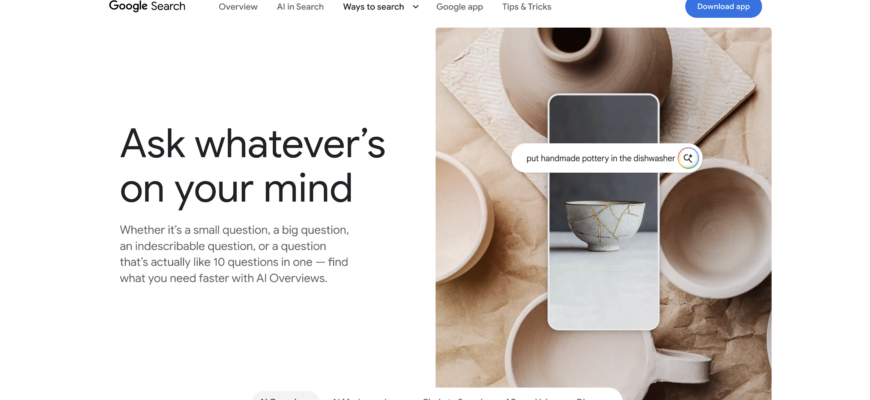
AI Overviews are AI-generated summaries that appear at the top of Google Search results, synthesizing information from multiple web sources to answer user queries directly on the search page. They show a concise answer followed by clickable citations, typically above the classic results.
They appear in a distinct visual format (often a shaded box), separate from standard blue links. Citations usually link to 3–7 sources, though some queries trigger Overviews with far more references. Unlike featured snippets (single-source extraction), AI Overviews synthesize across multiple pages and can rotate sources between refreshes. That source rotation is one reason teams often describe the feature as having limited algorithmic transparency.
If you want to optimize for AI Overviews, you need to understand two things at once:
- How citations work in practice (what you can observe)
- How Google retrieves, grounds, and selects passages (what you can design for)
Terminology + Boundaries
AI Overviews aren’t the same as other SERP features:
- Featured snippets: extract from a single source and appear in a different layout position
- Knowledge panels: show structured entity data (people, places, brands), not synthesized answers
- “People also ask” boxes: expandable Q&A, but they don’t generate new text
- Traditional organic results: rank pages without AI summarization
- AI Overviews: trigger when Google predicts users want a synthesized answer—not a list of links
Citation Mechanics (What’s Observable)
AI Overviews typically cite between 3 and 7 sources per answer, though roughly 2.7% use over 25 sources. Citations can appear as in-line links or as numbered references below the text.
You’ll also see frequent citation rotation across refreshes, even for identical searches. And “Core Sources”—pages cited most often for a topic—may represent only a small portion of the total pool, with most citations coming from a rotating set of secondary pages.
Importance
Why SEOs Should Care
AI Overviews change what “visibility” means:
- Reach/visibility implications: AI Overviews now reach 2 billion monthly users. If you’re cited, you’re visible at scale—even when clicks are compressed.
- Click behavior implications: Roughly 60% of searches yield no clicks. Citations can become a substitute for traditional traffic, shifting value toward brand exposure and authority signals.
- Competitive dynamics: Half of AI Overviews use 7 or fewer sources, and 70% of cited pages come from Google’s top 10 organic results. So if you’re not already competing on page one, prioritize classic ranking improvement (including link building) while improving passage extractability.
When AI Overviews Help vs. Hurt
Potential upside:
- Brand visibility: Your domain appears alongside trusted sources, reinforcing authority even without a click.
- Assisted discovery: Visibility can drive delayed conversion via branded searches, supporting customer journeys.
Potential downside:
- Reduced clicks: AI Overviews are associated with a 34.5% average reduction in organic clicks on the top result.
- Attribution ambiguity: Citations don’t always map clearly to specific claims, complicating credit and ROI reporting.
Eligibility
Prerequisites (Must Be True)
- Indexable and crawlable: No
noindextags or crawl blocks - Content accessible without barriers: Avoid paywalls/login walls/excessive interstitials
- Clear main content: The primary answer can’t be buried in navigation or sidebars
Selection Signals (Improve Odds, Not Guarantees)
- Ranking proximity: 70% of AI Overview sources rank in Google’s top 10.
- Topical relevance: Semantic relevance, related entities, and LSI keywords (e.g., “search visibility,” “user intent,” “content optimization”) often sit at the intersection of on-page SEO and semantic analysis.
- Clarity of answers: Direct answers near the top—lists, tables, and short paragraphs—are easier to extract and synthesize.
Non-Guarantee Statement
Even if you meet every prerequisite, inclusion can vary by query phrasing, geography, language settings, and time. Google’s selection is dynamic: you may appear for one variant and disappear for another.
How AI Search Selects and Generates Sources
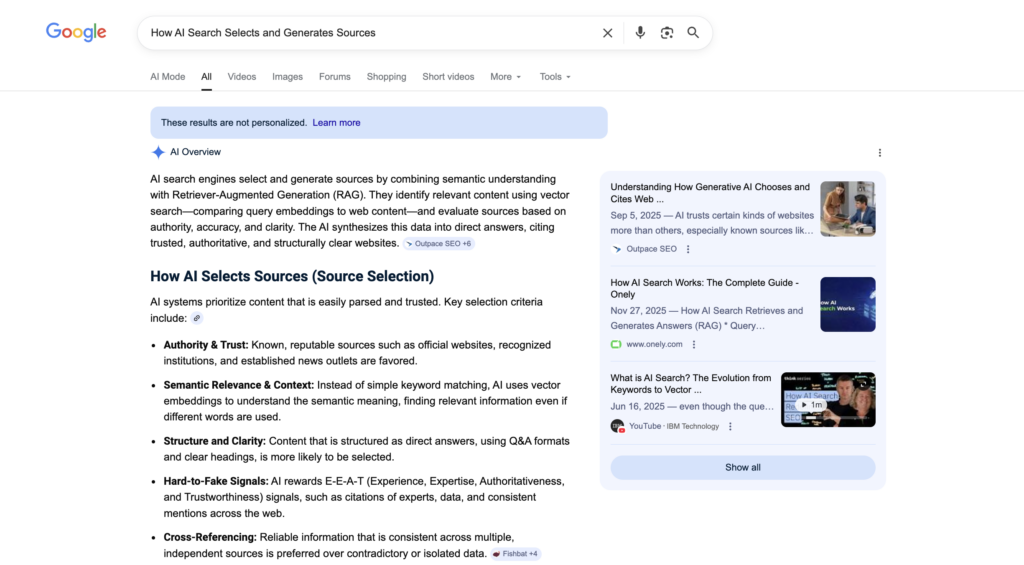
If you want predictable progress, optimize for how AI Overviews build an answer. In practice, the process resembles a three-stage pipeline:
- Query understanding + feature extraction
- Retrieval + grounding
- Source selection + citation
Each stage is a filter. Fail early, and you never enter the candidate set. Pass retrieval but fail grounding, and you won’t be cited. Rank well but write vague, hard-to-quote passages, and you’ll lose to a competitor with cleaner formatting.
Feature Set
AI systems look for candidate eligibility signals that make passages safe to extract and easy to ground:
- Explicit question-answer alignment
Implementation: Put the topic in sentence one, answer it in sentence two. - Passage-level specificity
Implementation: One paragraph, one purpose. Don’t mix subtopics. - Entity clarity
Implementation: Prefer “Google Search Console reports crawl errors” over “It reports errors.” - Freshness indicators
Implementation: Use “Updated March 2026” notes or inline “as of [year]” markers. - Extractable formatting
Implementation: Use numbered steps, lists, and definition blocks instead of long prose.
Anti-signals reduce extractability and trust:
- Heavy lead-in fluff before the answer
- Ambiguous pronouns that obscure entities
- Mixed intent sections on one page
- Claims that read like opinion without citations or data
The constraint is straightforward: if the model struggles to attribute, extract, or validate your passage, it won’t risk citing you.
Retrieval and Generation
AI search often uses retrieval-augmented generation (RAG): retrieve passages from the index, then generate an answer grounded in those passages.
For SEO, the implication is direct:
- If retrieval fails, you can’t be cited
- If grounding fails, you may be excluded
Two edge cases to plan around:
(a) Multi-intent queries with query fan-out:
If the model decomposes “How does SEO work?” into sub-questions, it will retrieve at the passage level. If your content buries each subtopic without clear headers, retrieval can fail.
(b) Nuanced questions requiring corroboration:
For “Is keyword density still important in 2026?”, the system may prefer consensus. Outlier claims without evidence are harder to ground.
Passage-indexing instruction set:
Design each passage to stand alone:
- The claim
- The scope/conditions
- A definitional anchor (named entity/term)
Source Selection
After retrieval and grounding, the system decides what to cite based on:
- Relevance to the sub-question
- Quote-ability/extractability
- Trust calibration (evidence/consistency)
Citation footprint planning:
AI Overviews usually cite a limited set of sources. Half use 7 or fewer sources, and only 2.7% cite over 25 sources. About 70% of sources come from the top 10 organic results. That means you’re optimizing for ranking + passage extractability at the same time.
If you rank #11, moving into the top 10 can matter more than rewriting a paragraph. If you rank #3 and still aren’t cited, you likely have an extractability or trust problem (vague phrasing, poor formatting, no supporting evidence).
Query Targeting for AI Overviews
AI Overviews trigger more often for queries with predictable structure. Before you target a keyword, run it through five checks:
- Answerability: supports a 50–70 word neutral synthesis
- Decomposability: breaks into 2–4 follow-ups
- Verifiability: can be supported with facts/definitions/steps
- Competitive scarcity: fewer than 10 authoritative sources cover it well
- User clarity: intent is unambiguous
That filter keeps you out of “AI Overview shows up, but there’s no realistic citation opportunity” territory.
Long-Tail Queries
Long-tail queries win because they force specificity. Four patterns tend to perform well:
- Modifier-heavy queries:
[core term] + [audience] + [use-case] - Constraint-based queries:
[solution] + [technical constraint] + [budget/time/compliance] - Comparison-with-constraint queries:
[A] vs [B] for [constraint] - Scenario-based queries:
[action] when [scenario]
Use the 0–2 scoring rubric to prioritize without tools:
- Answerability (0–2)
- Decomposability (0–2)
- Factual verifiability (0–2)
0–2: discard
3–4: test
5–6: prioritize
If you do use tools later, treat search volume and keyword difficulty as secondary filters after structure-fit.
Question Queries
Question form often determines what gets cited. These formats map well to AI Overview answer units:
- “What is” → bolded term + 20–40 word definition near the top
- “How to” → numbered steps with imperative verbs
- “Why does” → cause → mechanism → effect, with at least one example
- “Is X worth it” → decision checklist with thresholds
- “Which is better” → decision table + “best for” mapping
- “What are the risks” → risk bullets with severity + mitigation
For multi-intent questions, explicitly build for query fan-out: one H3 per follow-up question, with a 40–80 word answer directly under each.
When a query is ambiguous (“best,” “cheap,” “fast,” “safe”), rewrite it using:
- Constraint disambiguation
- Audience disambiguation
- Context disambiguation
Then update your on-page answer to match that rewritten version precisely.
Intent Mapping
Intent decides both phrasing and the “shape” of a citeable answer:
- Informational → definition-first, with example + proof
- Comparative → decision table + trade-offs
- Procedural → numbered steps + error handling + success criteria
- Diagnostic/troubleshooting → symptom → cause → fix bullets
Before you commit, do a SERP reality check:
- Is an AIO present?
- Which subquestions show?
- What source types are cited?
- What answer format is shown?
- Does it display steps or tables you need to match?
Citation competition note: Finch’s research shows AI Overviews cite fewer than six sources for many queries, with most drawn from top-10 organic results. If you aren’t a realistic top-10 candidate, prioritize other queries or fix ranking proximity first.
Content Structure for AI Overview Inclusion
If you want citations, write like your content will be extracted out of context—because it will be.
Implementation rule set: Use answer-first formatting, keep blocks self-contained, place direct responses within the first 100 words of each section, avoid nested complexity beyond one level, and ensure every block contains the primary entity name plus qualifier. If a passage stays clear after you delete everything around it, it supports a repeatable SEO process.
Answer Blocks
Answer blocks are standalone units built for extractability:
- Direct Answer (50–70 words): best for definitions and “what is”
- TL;DR bullets (3–5 bullets): best for summaries and lists
- Step / Process mini-block (3–7 steps): best for “how to”
Use the answer-first, then support rule: answer block first, then 1–2 short support paragraphs (max ~120 words) before the next subheading.
Formatting
Formatting is a technical lever here:
- Keep answer-block sentences ~12–20 words
- Avoid deep list nesting (max one level)
- Keep list items parallel and single-purpose
- Bold key terms sparingly (once per paragraph)
- Repeat the full entity name at first mention in each section (don’t rely on pronouns)
Copy-paste ready template:
## [Question or Topic Heading]

**Direct answer:** [50-70 word self-contained response that includes primary entity name].

Key takeaways:
- [Independently meaningful bullet 1]
- [Independently meaningful bullet 2]
- [Independently meaningful bullet 3]

[Short support paragraph 1: mechanism or evidence, max 60 words]

[Optional short support paragraph 2: implication or example, max 60 words]
Tables
Tables compress meaning into extractable units.
Use:
- A Decision table (intent → format → example → why it extracts)
- A Do / Don’t table (mistake → corrected pattern)
Keep tables scannable (6–8 rows), avoid merged cells, and use descriptive headers.
Headings
Headings are chunk boundaries for passage indexing:
- Keep one intent per heading
- Prefer question headings for question queries, but vary patterns
- Start each H3 section with the subject noun (not “this” or “it”)
- Include at least one threshold/constraint per H3 for quotability
- Avoid duplicating rules across sections; reference them by name (Overlap control rule)
Content Quality Signals (E-E-A-T)
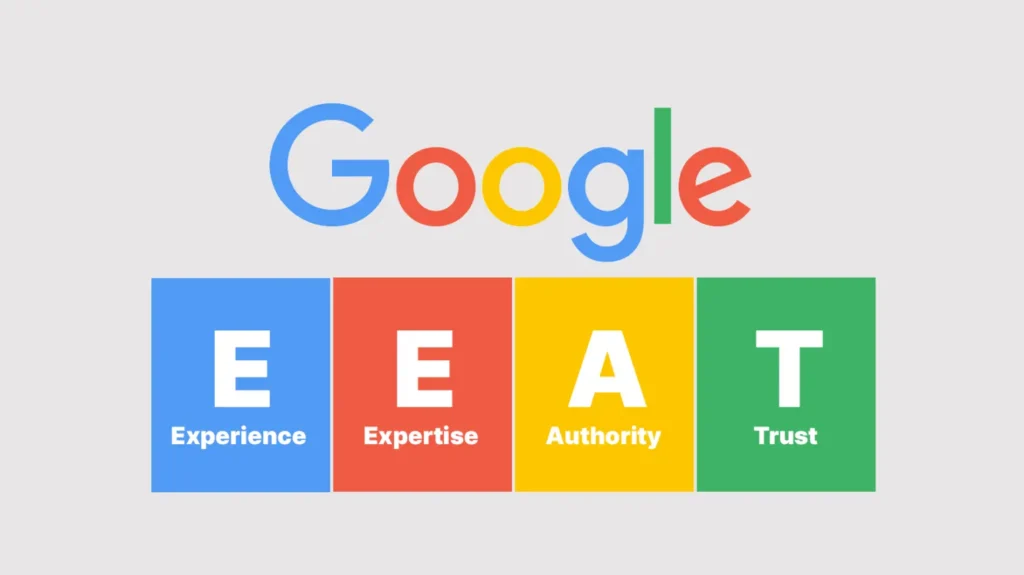
E-E-A-T is abstract until you translate it into on-page signals that can be extracted: citations, identity blocks, review stamps, timestamps, and change logs. These are trust markers that can support higher quality extraction.
Primary Sources
Use primary sources whenever they exist, and apply claim-to-source mapping for any quantitative, medical, legal, or financial claim. Manage freshness by distinguishing stable topics (annual review) from volatile topics (monthly or event-driven review). Evaluate external references with the six-point rubric (recency, transparency, publisher authority, directness, conflicts, reproducibility).
Authorship
Make authorship machine- and human-readable:
- Full name, role, organization, credibility statement, author page link (
/author/carlos-silva/) - Verifiable experience details (tools, timeframes, scope)
- Schema consistency (
Person+ matching naming)
Use heightened standards for YMYL.
Editorial Review
Add an auditable review layer:
- “Reviewed by” line with credentials + date + verification scope
- Visible change log for substantive updates
- Fact-checking checklist and corrections mechanism/policy
These signals help both users and systems trust your content.
Topical Authority and Internal Linking
AI Overviews don’t only evaluate a single page. Retrieval systems also learn whether your site is consistently useful across a topic—one reason topic clusters and internal linking can raise organic traffic and citation eligibility.
Topic Clusters
Build a hub-and-spoke cluster:
- Hub/pillar guide
- Deep-dive spokes
- Glossary/definition/support pages
Assign “query fan-out” subtopics to the right page role. Each deep-dive should answer 3–5 sub-questions, include 1–2 explicit entity relationships, and link back to the hub plus at least two peer pages.
Internal Linking
Define link types (hub→spoke, spoke→hub, spoke→spoke, glossary→spoke) and enforce anchor rules:
- Descriptive anchors
- 2–3 variants per target page
- Avoid sitewide exact-match repetition
- No vague anchors (“click here”)
Entity Coverage
Create an “Entity Set” for the cluster and use explicit relationship statements (semantic triples). Keep naming consistent (“AI Overviews,” not “AIO”), disambiguate first mentions, and ensure each entity connects to others via internal links.
Structured Data for AI Overviews
Structured data helps Google parse entities, facts, and relationships more reliably. It’s a clarity layer—not a shortcut—and it does not guarantee inclusion in AI Overviews.
Schema Types
Match schema to page intent:
- Informational:
Article/NewsArticle - Q&A:
FAQPage(only if Q&A is visible) - Instructions:
HowTo - Commercial:
Product - Credibility:
Organization/Person
Schema supports entity clarity and disambiguation. It doesn’t automatically boost rankings, but it can make strong content easier to interpret and attribute.
Avoid high-risk mistakes (FAQ spam, invisible content, Product schema misuse, mismatches vs. visible text, stale dateModified).
Implementation
Use JSON-LD and aim for one unified graph per page:
- Prefer
@graphto connect Organization, WebSite, WebPage/Article, Person - Avoid duplicative blocks from plugins + custom code
- Standardize
@idreferences
Workflow:
- Pick page intent
- Choose primary schema type
- List required properties
- Align every claim with visible content
- Connect nodes via
@id - Deploy
- Validate
- Re-validate after CMS edits
Validation
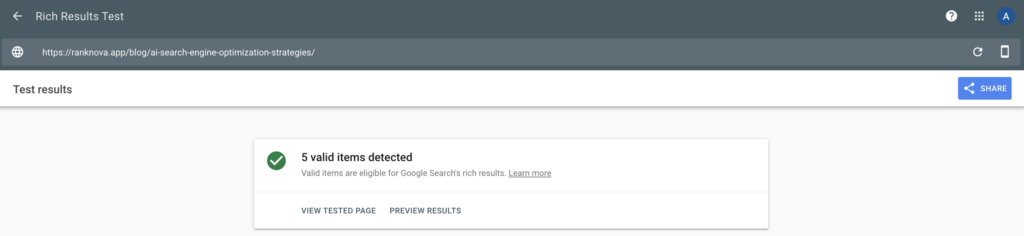
Use a two-tool minimum:
- Rich Results Test (https://search.google.com/test/rich-results)
- Schema Markup Validator (https://validator.schema.org/)
Fix errors immediately. Treat warnings as backlog items, but don’t ignore persistent ones. Then monitor schema drift (FAQ removed but schema remains, author changes, stale dates, offers mismatches).
Technical SEO Requirements
Technical SEO is your eligibility layer. If Googlebot can’t fetch, render, and index your pages, your content and schema won’t matter for AI Overviews.

Crawlability
Crawlability covers access control, discovery, and crawl efficiency:
- Robots directives (meta + headers + robots.txt)
- XML sitemap structure
- Canonicals and internal link discoverability
- Parameter handling and faceted navigation controls
Verification steps:
- GSC URL Inspection → Test live URL
- Coverage report → “Crawled—currently not indexed” patterns
- Log file analysis → Googlebot status codes
Indexing
Indexing requires consistent signals: 200 status, correct canonical, no noindex, no robots blocks, and content visible in rendered HTML. Watch for contradictions (canonical + noindex conflicts), pagination canonical mistakes, and soft 404 patterns.
Verification steps:
- GSC URL Inspection → indexing allowed + canonical alignment
- Avoid
site:operator diagnostics; use Search Console instead
Performance
Slow sites lose crawl frequency and render reliability. Focus on Core Web Vitals (LCP, INP, CLS), reduce TTFB, and manage third-party scripts.
Verification steps:
- PageSpeed Insights / Lighthouse
- GSC Core Web Vitals report
- Server monitoring for TTFB patterns
Mobile
Mobile-first indexing makes parity non-negotiable: content, headings, internal links, and structured data should match between mobile and desktop.
Verification steps:
- GSC Mobile Usability report
- URL Inspection → “View crawled page” with smartphone Googlebot
- Manual testing on throttled mobile connections
Rendering
Critical content should exist in server-rendered HTML where possible. Client-side rendering introduces timeouts, blocked resources, and hydration errors.
Verification steps:
- URL Inspection → rendered HTML + screenshot
- Compare source HTML vs. rendered DOM
- Resolve any blocked CSS/JS resources
Technical sign-off before chasing AI Overview citations
- Test live URL passes (successful fetch and render)
- Chosen canonical correct (Google-selected matches user-declared)
- No indexing contradictions (no noindex + canonical conflicts, no soft 404s)
- Mobile parity confirmed
- Core Web Vitals not failing (field data thresholds pass)
- Rendered HTML contains primary answer
- No blocked resources
- Crawl efficiency optimized (canonical URLs 200, parameters handled, no orphan pages)
Measurement and Reporting
You can’t manage what you don’t instrument. AI Overviews require a separate measurement layer because Search Console doesn’t label them as a distinct feature.
Track six metrics:
- AIO citation count (owned URLs)
- AIO-triggered query set size
- Delta in clicks/CTR for AIO-trigger queries
- Crawl & index coverage for candidate pages
- Rank distribution for cited vs non-cited pages
- No-click risk note (impressions up, clicks down)
Search Console
Build an “AIO candidate query set”:
- Export queries (last 28 days)
- Filter for modifiers (“how,” “what,” “why,” “best,” “vs,” “top”)
- Tag intent
- Track weekly deltas in impressions/clicks/CTR
- Keep stable thresholds (add at 100+ impressions; remove after sustained drops)
Then run URL-level diagnostics (crawl date, indexed status, canonical, mobile usability, rich results eligibility) and maintain a one-row-per-URL health table.
Expect CTR interpretation to change: impressions can rise while CTR drops for AIO-triggering queries, which is why cohort reporting matters—especially when you’re monitoring downstream effects like conversion rates.
Log Files
Logs show crawl behavior at a level Search Console can’t:
- Filter Googlebot hits for AIO-target pages
- Compute crawl frequency, status distribution, recrawl lag after updates
- Escalate persistent 5xx rates >2% or recrawl lag >14 days (relative to your baseline)
Measure crawl-rate deltas after internal linking improvements to prove impact.
Rank Tracking
Separate tracking groups:
- “AIO Triggers”
- “Control” (similar intent, rarely triggers AIO)
Capture SERP context (AIO present Y/N, top-10 rank). If your tool doesn’t detect AIO, implement a manual sampling protocol with screenshots and consistent locale/device settings.
Citation Tracking
Track citations as two types:
- URL citations (links)
- Brand-only mentions (no link)
Use a tiered method stack:
- Manual spot checks (small sets)
- SERP capture tooling exports (scale + history)
- Referral monitoring (hypothesis signals only)
Build a master reporting table: Query, Intent, Locale, Device, AIO present, Site cited, Cited URL, Organic rank, GSC impressions/clicks, Notes.
Common Mistakes That Prevent Inclusion
AI Overviews cite a small set of sources. Most pages lose before selection because of avoidable issues.
Keyword Stuffing
Excessive repetition reduces semantic clarity and can trip quality filters. Keep one primary phrase in the opening answer block, then rely on clear entities and attributes without robotic repetition.
Thin Content
Thinness is missing constraints, steps, examples, and evidence—not just low word count. Every core section should include a direct answer plus supporting structure (bullets/steps/examples) and verifiable references where applicable.
Mismatched Intent
Intent mismatch is a fast disqualifier. “How to” queries need steps. Comparisons need criteria and trade-offs. Informational queries need mechanisms—not sales copy.
Outdated Content
Fast-moving topics require visible review cycles. Add “Last reviewed” timestamps, refresh screenshots, and include the data year for statistics to avoid false recency.
Triage order: mismatched intent → thinness → outdated content → keyword stuffing.
FAQ
How long does it take to appear in AI Overviews?
AI Overviews typically show citations weeks—not days—after Google crawls and indexes your changes, but volatility makes timelines unpredictable.
Expect three stages: Implement changes → Re-crawl/Index → Eligibility/Selection volatility. Rendering issues, canonical conflicts, and stale pages can extend beyond the typical 2–4 week window.
What to do next:
– Use URL Inspection to confirm crawl/index status
– Check “View crawled page” for rendered answer blocks and schema
– Monitor query-level trends in Search Console
– Cross-check Technical SEO Requirements and E-E-A-T sections for blockers
– Review Snippet Controls/Robots Controls if you’ve restricted previews unintentionally
Does schema guarantee inclusion?
Schema markup does not guarantee inclusion in AI Overviews. It supports eligibility and understanding, but it can’t override relevance, quality, or source selection logic.
Validate using Rich Results Test and Schema Markup Validator (Structured Data for AI Overviews > Validation), and keep schema aligned with visible page content.
Can small sites appear in AI Overviews?
Small sites can appear if they outperform larger competitors on relevance, topical authority, and E-E-A-T signals—especially via first-hand experience, unique data, narrow topical authority, clear answer blocks, strong citations, and tight internal linkin
How to prevent content from being used in AI Overviews?
You have three control levels:
Snippet prevention: nosnippet, max-snippet:0, data-nosnippet
Indexing exclusion: noindex or robots.txt Disallow
Partial visibility limits: max-snippet:[number] + data-nosnippet
Trade-offs include reduced visibility and lost rich results eligibility. Validate changes in Search Console URL Inspection before deploying wide
How to measure AI Overview citations?
Use a three-layer plan:
1. Manual SERP sampling
2. Search Console proxy metrics (impressions/clicks/CTR by query/page)
3. Third-party/automated citation tracking
Keep “citations” (confirmed URL attribution) separate from “influence” (qualitative similarity) in reporting.
Implementation Checklist (Next 7 Days)
- Content Structure for AI Overview Inclusion: Add 1 answer block per priority query page using the Answer Blocks format; validate with on-page QA.
- Schema Markup and Structured Data: Deploy FAQ or HowTo schema on 3 target pages; test with Rich Results Test and confirm indexing in Search Console within 72 hours.
- Technical SEO and Indexability: Run a crawl audit for orphaned pages and crawl errors; fix the top 5 blockers (see Indexability and Crawlability diagnostics).
- Topical Authority and Internal Linking: Build or update 1 hub page linking to 5–7 related topic pages; confirm the link graph matches Topical Authority and Internal Linking.
- Query Targeting and Optimization: Map 5 high-priority queries to existing content using the Query Targeting framework; rewrite meta descriptions to match AI Overview snippet style and test variants for voice search.
- Measurement and Reporting: Set up Search Console filters for AIO-eligible queries; export baseline impressions/clicks.
- Key Considerations, Risks, and Controls: Document 3 canary pages to monitor traffic shifts; schedule a 14-day check-in.
Measurement Baseline
Before deploying changes, record:
- Impressions and clicks for your top 10 AIO-eligible queries (Search Console; position 1–5 filter)
- Crawl frequency for priority pages (logs; weekly average over 28 days)
- Rank and citation presence for target queries (rank tracker + citation tracking)
Re-check 14–28 days post-deployment to account for indexing lag and reduce noise.
Risk and Expectations
AI Overviews sit inside a broader zero-click environment. Research shows 25.6% of desktop searches and 17.3% of mobile searches result in zero clicks, and Overviews can further compress CTR.
Google selects a small citation set (often 3–5 links), heavily skewed toward top organic results. Attribution will stay messy as reporting catches up. That makes measurement and controls essential: isolate signal from noise, protect high-value pages from cannibalization, and invest in conversion-focused on-page experience and brand demand. Treat AI Overviews as an additional visibility surface—not a replacement for rankings and not a guaranteed traffic driver—especially as visual search increases the importance of structured media signals and on-page context.
If You Only Do One Thing
Add answer blocks (from Content Structure for AI Overview Inclusion) to your top 5 landing pages for high-intent queries. It’s the fastest structural change that improves both classic snippet eligibility and AI Overview extraction potential.